European Protests Spread to Milan and Lisbon as Anger Over Living Costs Boils Over
Violent clashes in Milan and a new tent encampment in Lisbon mark the expansion of a broad European wave of protests rooted in housing affordability, stagnant wages, and public service deficits.
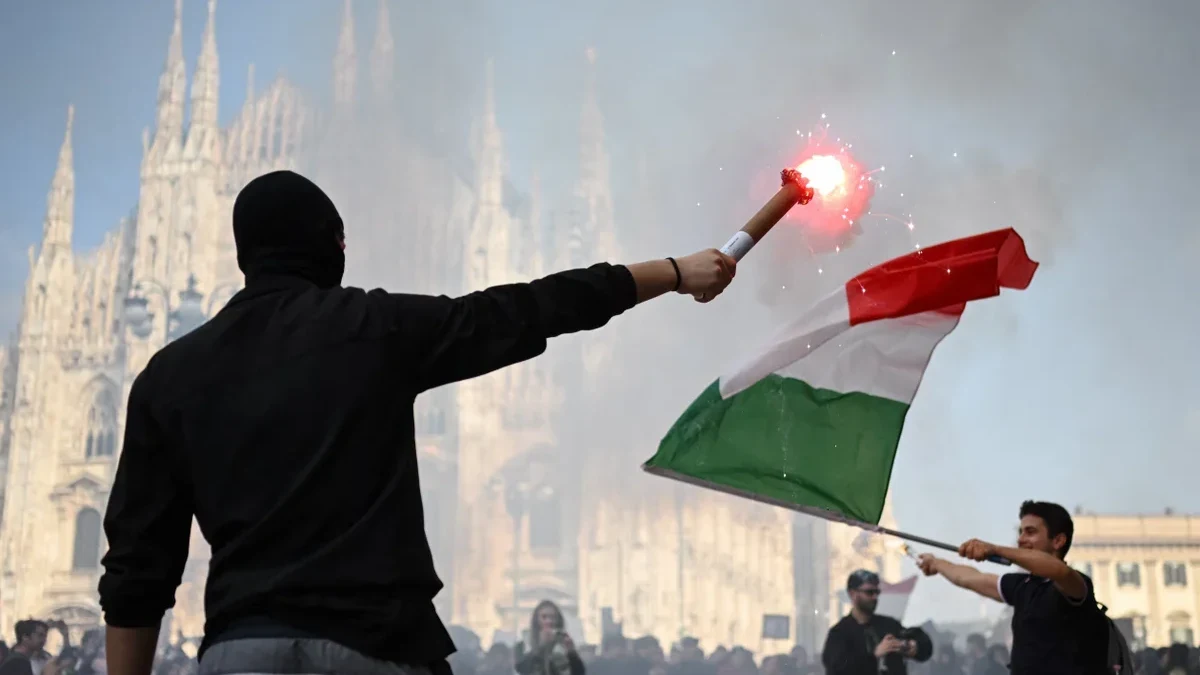
The wave of angry protests that convulsed Spain and France in recent weeks has spilled over into Italy and Portugal, with violent clashes erupting in Milan and a tent encampment springing up in the Portuguese capital. In Milan, a march against rising living costs began peacefully but turned violent when masked rioters threw stones and set fire to barricades, prompting police to deploy tear gas and water cannons. Officials and state media reported that at least two police officers were injured and approximately 50 demonstrators, many of them minors, were detained during the unrest.
In Lisbon, the movement centered on a massive rally at Rossio Square, where hundreds of protesters established a tent camp to highlight the housing crisis. This encampment mirrors a similar protest camp that was established in Madrid three weeks earlier. As demonstrators sat around the statue of King Pedro IV in the busy square, they vocalized their grievances over the soaring cost of basic necessities and the government's handling of the real estate market.
Underlying the Portuguese mobilization is a severe and persistent increase in real estate costs. Official data indicates that Portuguese housing prices rose by 124% between 2015 and 2024, a rate roughly twice as fast as the European Union average. The impact of this inflation has been particularly harsh on younger demographics, with nearly a quarter of the country's more than 11 million residents living in the Lisbon metropolitan area. This acute pressure has driven workers and tenants onto the streets to demand structural policy changes.
The political response in Italy condemned the destruction accompanying the demonstrations. Prime Minister Giorgia Meloni stated on social media that while the right to demonstrate is protected, setting cities ablaze is not. She argued that a specific group of rioters had exploited the movement to attack security personnel and hold cities hostage. Milan Mayor Giuseppe Sala similarly stated that the protesters' underlying grievances were understandable, but the violence against law enforcement and the resulting damage to the city were not justifiable.
In Portugal, Prime Minister Luís Montenegro acknowledged that the government understood the public's desire to express outrage over perceived omissions in public policies. However, he also warned political rivals against attempting to import into Portugal climates of instability and protest that, in his view, have no support in Portuguese society. This warning was widely interpreted as a response to the violent, decentralized style of unrest that has recently dominated France and Spain.
Simultaneously, violent demonstrations have occurred in Albania, where protesters angry over university conditions and high tuition fees demanded the resignation of the country's prime minister. The escalation of violence in Tirana involved the throwing of rocks and Molotov cocktails, with police firing rubber bullets at the crowds for the first time since the protests began. The broader European unrest reflects a convergence of economic pressures, with public anger over everyday life becoming a defining political challenge for governments across the continent.
Sources6
Original reporting and primary evidence.
- TheGuardianPrimary source‘We are suffocating’: protests spread to Lisbon and Milan as housing and living cost tensions intensify
- www.babushahi.comEurope on Fire: Violent protests rock France, Belgium, Italy and Portugal; 1,200 arrested in France
- www.oneindia.comSeason Of Protests: Not Just India, These Countries Are Also Witnessing Demonstrations Around The World
- www.msn.comInflation and Inequality Ignite Streets Across the World
- 77.ltProtestai persimetė į Lisaboną ir Milaną: „dūstame“ nuo būsto kainų
- www.msn.comMassive protests rock France; historic Limoges city hall set ablaze, 1,200 held; smaller rallies hit 3 nations
Claim connections10
The wave of angry protests that convulsed Spain and France in recent weeks has spilled over into Italy and Portugal, with violent clashes erupting in Milan and a tent encampment springing up in the Portuguese capital.
confirmedConnected sources1
In Milan, a march against rising living costs began peacefully but turned violent when masked rioters threw stones and set fire to barricades, prompting police to deploy tear gas and water cannons.
confirmedConnected sources2
Officials and state media reported that at least two police officers were injured and approximately 50 demonstrators, many of them minors, were detained during the unrest in Milan.
confirmedConnected sources1
In Lisbon, the movement centered on a massive rally at Rossio Square, where hundreds of protesters established a tent camp to highlight the housing crisis.
confirmedConnected sources1
Portuguese housing prices rose by 124% between 2015 and 2024, a rate roughly twice as fast as the European Union average.
confirmedConnected sources1
Prime Minister Giorgia Meloni stated on social media that while the right to demonstrate is protected, setting cities ablaze is not.
confirmedConnected sources1
Milan Mayor Giuseppe Sala similarly stated that the protesters' underlying grievances were understandable, but the violence against law enforcement and the resulting damage to the city were not justifiable.
confirmedConnected sources1
In Portugal, Prime Minister Luís Montenegro acknowledged that the government understood the public's desire to express outrage over perceived omissions in public policies.
confirmedConnected sources1
He warned political rivals against attempting to import into Portugal climates of instability and protest that, in his view, have no support in Portuguese society.
confirmedConnected sources1
In Albania, protesters angry over university conditions and high tuition fees demanded the resignation of the country's prime minister, with police firing rubber bullets at the crowds for the first time since the protests began.
confirmed