Serbia's Student List begins government formation talks following landslide victory over Vučić
Following a landslide electoral win, Serbia's untested Student List is preparing to form a government to dismantle 14 years of authoritarian rule, despite a deliberate lack of a formal leader and unclear transition timelines.
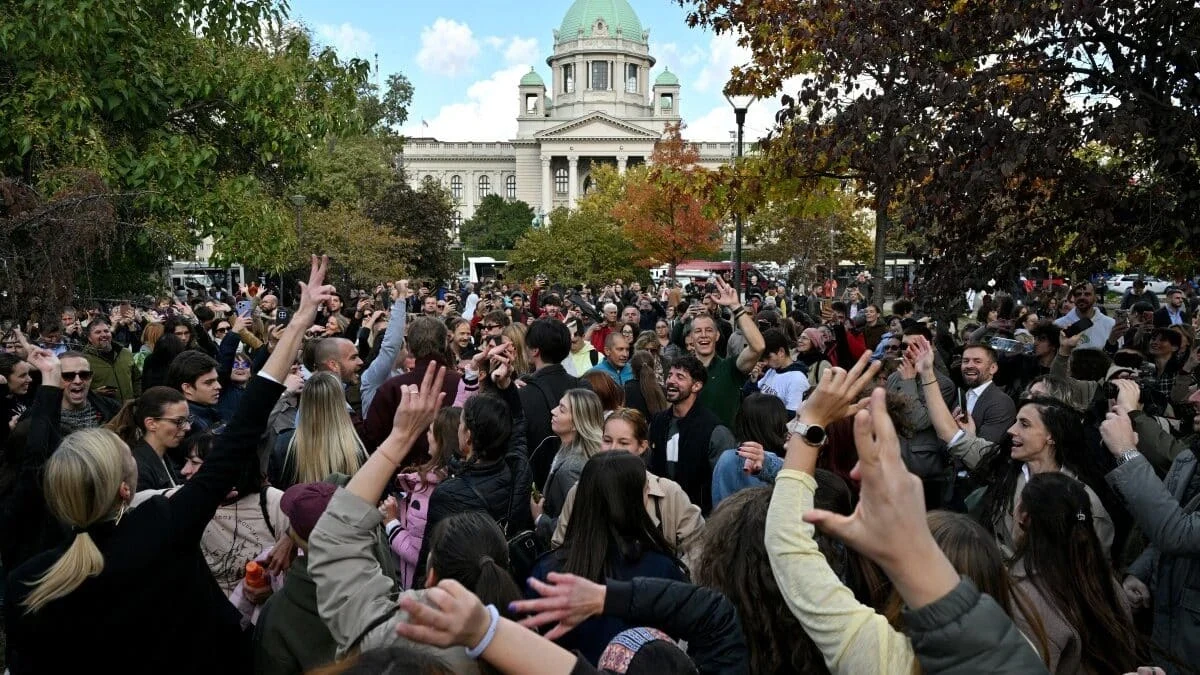
Serbia's Student List movement is preparing to begin negotiations to form a new government aimed at reversing 14 years of increasingly authoritarian nationalist rule under former president Aleksandar Vučić. A seismic electoral weekend resulted in the Student List capturing 53% of the vote, securing 141 out of 250 parliamentary seats, while the Serbian Progressive party dropped to 39%, prompting Vučić to concede defeat on Sunday.
The winning movement remains deliberately leaderless and lacks prior experience in governing. As the list relies on collective decision-making and a flat hierarchy with no clear prime minister or cabinet identified, the specifics of how the movement will function in power remain unclear. Prominent figures on the list, such as cardiologist Ilija Srdanović and former central bank governor Dejan Šoškić, stand as key faces in a group that has yet to outline its administrative structure.
Student List candidates have stated that the movement's primary objective is the social and psychological detoxification of the country, aiming to dismantle a system of intimidation and rebuild institutions from the ground up. The Student List has intentionally kept divisive foreign policy topics, including relations with Russia and the EU, in the background, focusing instead on domestic political issues. Analysts noted that the movement's collective candidate selection process took months and needs to be sped up for governance.
The Student List faces significant challenges as it must navigate public institutions staffed with civil servants loyal to the outgoing regime. While international leaders, including Ukrainian President Volodymyr Zelenskyy and German Chancellor Friedrich Merz, welcomed the victory and supported Serbia's European path, the Kremlin hoped the new leaders would recognize that cooperation with Russia remains in Serbia's best interests. Serbia's constitution requires the new parliament to convene within 30 days, with a 90-day deadline for forming the government.
Sources1
Reporting and evidence linked in this story.
Claim connections3
The Student List won 53% of the vote and secured 141 parliamentary seats, while the Serbian Progressive party won 39% of the vote and 103 seats, leading to Vučić's defeat.
confirmedConnected sources1
The Student List is a deliberately leaderless movement with no established hierarchy, making it unclear who will be appointed as prime minister or to the cabinet, and its collective candidate selection process has been criticized for being too slow.
confirmedConnected sources1
Prominent figures in the Student List, including Ilija Srdanović and Dejan Šoškić, have prioritized domestic political issues over divisive foreign policy topics, focusing on dismantling a system of intimidation and rebuilding institutions.
attributed